Forte’s Historic Villas
Forte dei Marmi offers far more than its beaches. For those who enjoy walking or cycling, the town reveals a wealth of natural beauty and refined architecture. Among its most captivating areas is Roma Imperiale, an elegant garden district created in the 1920s. Its name comes from the Società Cooperativa Anonima Roma Imperiale, which in the early 20th century purchased and subdivided the land, selling plots to affluent vacationers.


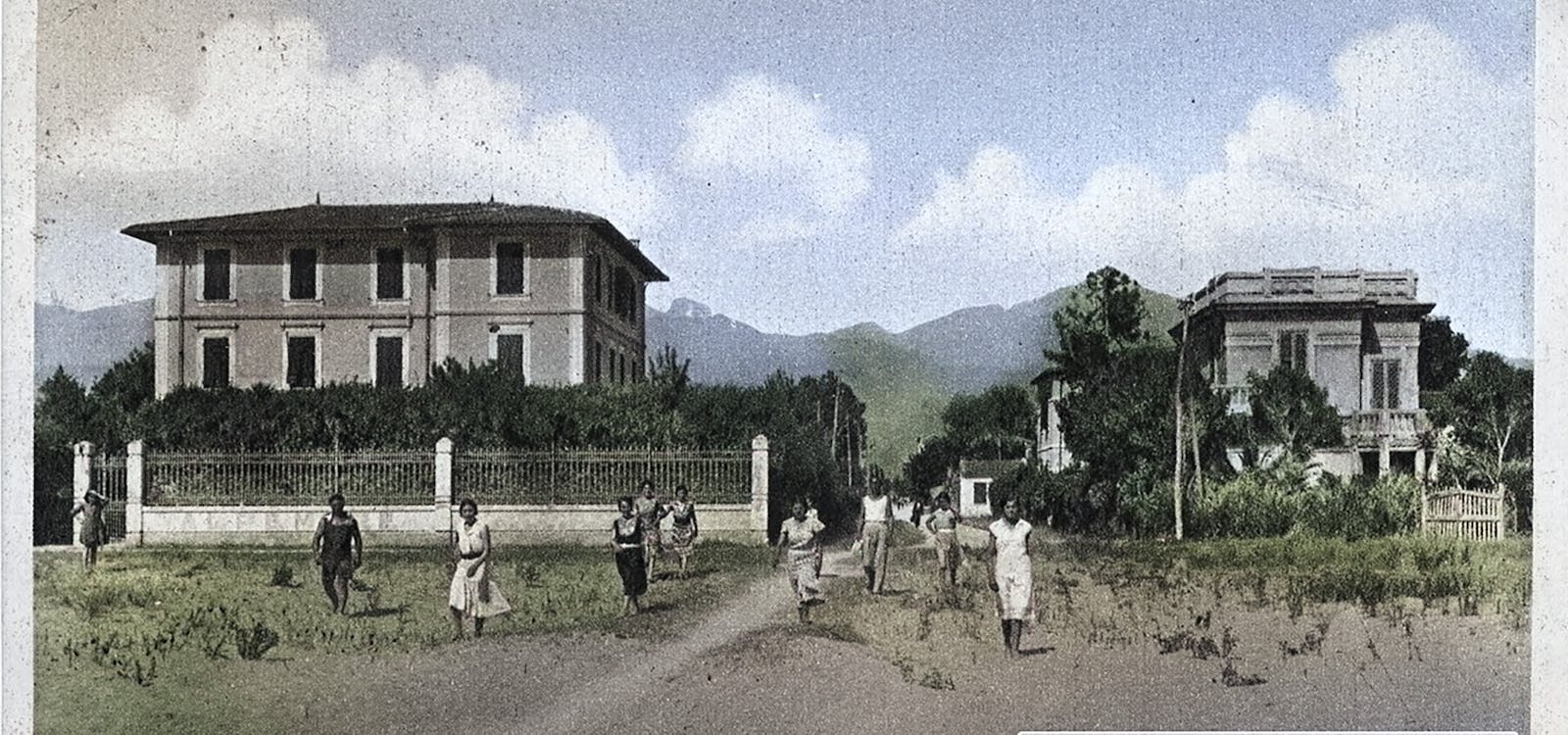
The Apuana Estate of Villa Siemens, pictured in a historic photograph
Set within a lush pine forest just steps from the sea, Roma Imperiale is a riot of diverse architectural styles, yet harmonious and coherent thanks to the skillful use of the same colors and materials: travertine, terracotta, local stone, and green shutters. An ideal cycling route begins near the historic Capannina and continues along the seaside bike path toward Marina di Pietrasanta.
Along this stretch, you encounter some of the earliest villas, dating back to the late 19th century, predating the Roma Imperiale development itself. Almost all of them were built for the first German families who spent their summers in Forte dei Marmi. The atmosphere was completely different at the time: with no seaside boulevard, villas stood immersed in the pinewood, with direct access to the beach. From this era comes the imposing Villa Apuana, designed by architect Carl Sattler for the tycoons of the German industrial giant Siemens, inspired by Tuscan Renaissance villas. The impressive estate extended nearly a kilometer inland and included a caretaker’s house that still exists today on Via Leonardo da Vinci.


The historic Villa Costanza (now the Augustus Lido)
Nearby stands the former Villa Costanza, now the Augustus Lido. Built in 1899 for Admiral Morin and sold to the Agnelli family in the 1920s, it was converted into a hotel in the 1960s. A careful restoration has preserved the atmosphere of its golden age.
Leaving the seafront and heading inland, you reach the Fiumetto canal, where painter Carlo Carrà used to work during his stays.
On Via Roma Imperiale appear some of the first villas built after the early 20th-century land subdivision: Villa Pedrazzi and nearby Villa Carrà, the artist’s summer residence and a gathering place for intellectuals and creatives. Both are now protected by Italy’s Ministry of Culture.


Villa Mann Borgese, designed by architect Leonardo Ricci
On Via Corsica, Villa Antonietta offers a fine example of Mediterranean rationalism, with its curved façade, continuous windows, and use of terracotta and wood–perfectly suited to a summer residence nestled in the pine forest just meters from the sea.
A detour along Via Raffaelli leads to Villa Mann Borgese, built in 1957 by Leonardo Ricci, a pupil of Giovanni Michelucci, for the daughter of German writer Thomas Mann. Its unique design led the owner to describe it as “an ocean liner ready to set sail toward the mountains.”
Heading back toward the sea along Via XX Settembre, you pass the former Pensione Franceschi, once a favored retreat for noble families vacationing in Forte dei Marmi.


The Pensione Alpemare (with Villa Soffici on the right)
The district of Vittoria Apuana also boasts remarkable villas: Villa Erminia, once owned by the Minister of Education Giovanni Gentile; the former Pensione Alpemare, where artists and intellectuals such as Carrà, De Chirico, Piacentini, Papini, the De Filippo, Moravia and De Sica stayed from 1924; the nearby home of Ardengo Soffici; and Villa Amelia, built in 1914 for neuropsychiatrist and University of Pisa rector Giovanni Battista Pellizzi.
The journey ends at Villa Bertelli, which was initially built as offices for an explosives company before becoming a hotel. Today, it stands as the vibrant center of Forte dei Marmi’s cultural scene. Exhibitions, concerts, and cultural talks animate the villa year-round, while a rich summer billboard of events makes evenings in Forte dei Marmi truly unforgettable.
A bike ride through Roma Imperiale

ph. Gabriele Ancillotti / ©ForteMagazine (reproduction prohibited)

ph. Gabriele Ancillotti / ©ForteMagazine (reproduction prohibited)

ph. Gabriele Ancillotti / ©ForteMagazine (reproduction prohibited)

ph. Gabriele Ancillotti / ©ForteMagazine (reproduction prohibited)

ph. Gabriele Ancillotti / ©ForteMagazine (reproduction prohibited)

ph. Gabriele Ancillotti / ©ForteMagazine (reproduction prohibited)