In the heart of town, between art and boutiques
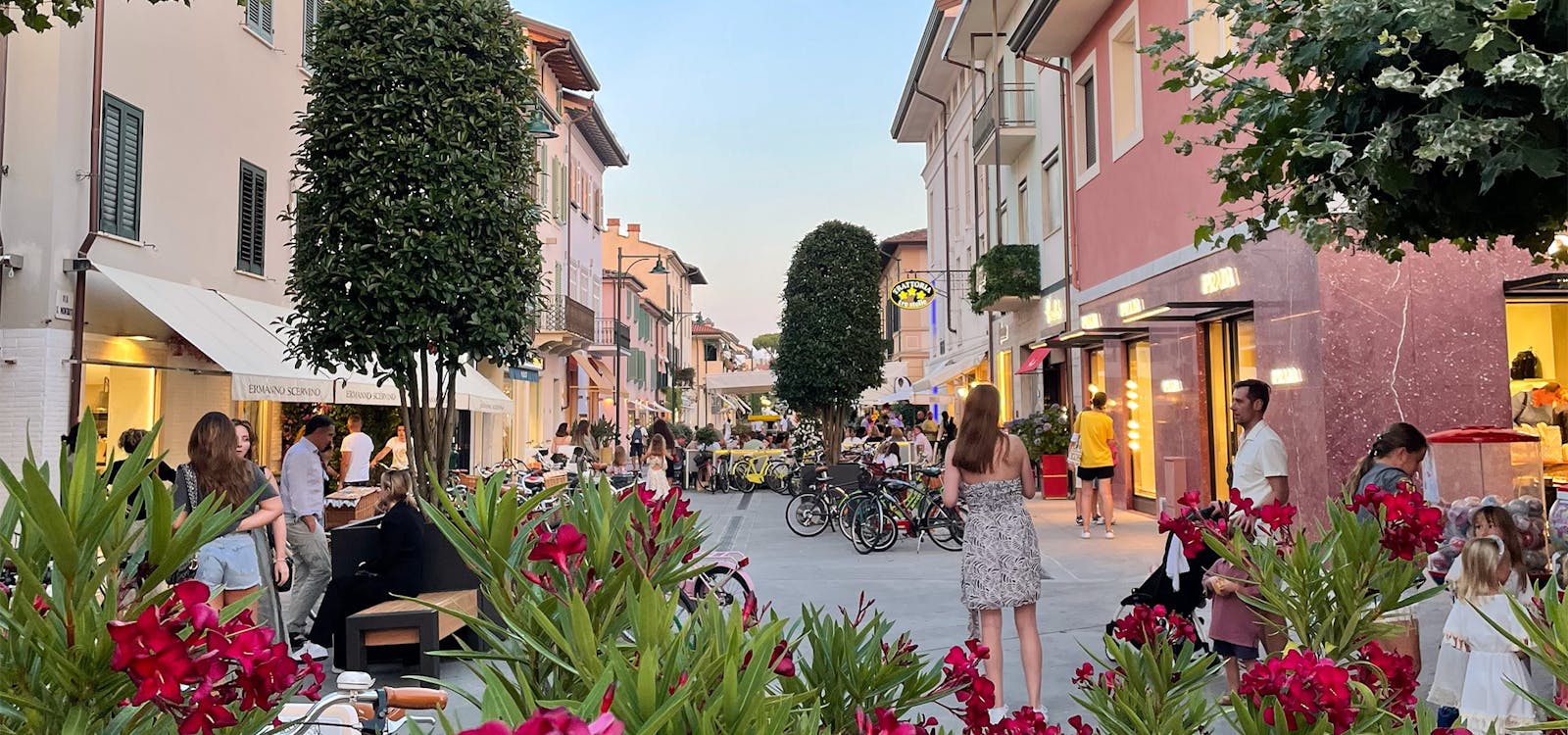
It is recommended to explore this short itinerary through the center of Forte dei Marmi on foot, or alternatively by bicycle for the longest stretch. Please note that the walk along the Pontile – from which one can enjoy sweeping views of the sea, the coastline stretching between La Spezia and Viareggio, and the Apuan Alps – is strictly reserved for pedestrians: vehicles and bicycles are not permitted. Each year, on August 28, the Pontile also becomes the spectacular stage for the grand fireworks display held in celebration of the town’s patron saint, Sant’Ermete.
In the circular square at the entrance to the Pontile, visitors can admire “Controvento”, a bronze sculpture by Anna Chromy, depicting a helmsman navigating toward the unknown. Crossing the seafront avenue toward the pinewood, one encounters the remains of the “Mancina,” the historic crane once positioned at the end of the Pontile to load marble blocks onto small vessels. The name “Mancina” derives from the fact that the crane’s rotation mechanism always turned to the left. Destroyed during the bombing of the Pontile in World War II, the structure was later recovered from the seabed and placed in this square, now dedicated to the workers of the sea.


“Controvento,” a sculpture by Anna Chromy on the Pontile
The walk continues past the pine grove dedicated to Falcone and Borsellino – where a traditional pattìno, the iconic Versilian lifeguard boat, is on display – and along Via Spinetti, the town’s main thoroughfare, framed by palm trees and lined with shops and boutiques. After just a few more steps, one reaches Piazza Garibaldi, the historic heart of Forte dei Marmi, dominated by the Fortino and the ancient well. The marble basin, once used as a watering trough for the animals transporting marble from the mountains to the sea, is still visible today, surmounted by the statue “Victory” by Arturo Dazzi. The square also features the historic fountain donated by the Municipality of Pietrasanta, as a source of fresh drinking water. Piazza Garibaldi regularly hosts concerts and performances, including the traditional Focata held in honor of the patron saint, Sant’Ermete. Visitors may pause on one of the many benches or enjoy breakfast or an aperitif at the famous Quarto Platano (now Caffè Roma), a celebrated meeting place in the early 20th century for intellectuals, artists, and writers such as Carrà, Dazzi, and Pea.

Piazza Garibaldi and the historic Fortino, symbol of the town
Continuing north from Piazza Garibaldi, the route leads to the elegant gardens of Piazza Dante, facing the building constructed in 1922 that now houses the Town Hall of Forte dei Marmi. At the center of the square stands a striking travertine marble monument dedicated to the fallen of all wars. The gardens are also home to “Figlia del Sole”, a sculpture by the renowned artist Giò Pomodoro.

A view of Piazza Dante with “Figlia del Sole” by Giò Pomodoro
Heading south from Piazza Garibaldi, past Caffè Principe, one arrives at Palazzo Quartieri, now home to the Municipal Library “Lorenzo Quartieri.” Recently renovated to offer cutting-edge multimedia services and host cultural events, the library boasts a rich and up-to-date collection, with particular attention to local history. Palazzo Quartieri overlooks the quaint Piazza Marconi, a distinctive circular square enclosing a dense pinewood and children’s playgrounds. This is where Forte dei Marmi’s famous open-air market takes place every Wednesday throughout the year and on Sundays during the summer season.

Piazza Marconi seen from above on a winter market day (photo by Federico Neri)
Continuing south, the walk reaches a small, atmospheric square featuring a marble bench-sculpture by Rosalda Gilardi, created as a tribute to the poet Eugenio Montale. From here, heading toward the sea, one arrives at the legendary nightclub La Capannina di Franceschi, a popular gathering place since the early 20th century.

The Eugenio Montale Square with the marble bench-sculpture by Rosalda Gilardi, dedicated to the great poet
The itinerary concludes by returning to the Pontile along the seaside promenade named after Achille Franceschi, the first owner of La Capannina and a key figure in the postwar tourism development of Forte dei Marmi. Along this avenue, near La Capannina, stands the marble bust of local actor Renato Salvatori, a leading figure of Italian cinema in the 1950s and 1960s.

The bust of Renato Salvatori near La Capannina di Franceschi