VisitForte events portal for tourism Forte dei Marmi


Fortino Leopoldo I
THE MEDICI
The origins of Forte dei Marmi can be traced back to the construction and use of a road known as the “Via di Marina,” which connected the inland areas to a maritime landing point along the coast. This route – believed to coincide with the road laid out by master sculptor Donato Benti, a collaborator of Michelangelo Buonarroti – was initially used for the transport of marble and, secondarily, for the trade of iron. During the Medici rule, marble quarrying increased significantly. Renowned master sculptors such as Michelangelo and Giambologna personally traveled to the area to select the stone for their works, relying on skilled local labor for extraction and transport.
LEOPOLD OF LORRAINE
On September 5, 1765, Peter Leopold of Habsburg-Lorraine was elected Grand Duke of Tuscany, a position he held until 1790. His governance was marked by forward-thinking reforms aimed at optimizing resources, liberalizing numerous public services, and streamlining an inefficient and cumbersome bureaucracy.
After reducing military expenditures, the Grand Duke decided to dismantle much of the maritime military fleet. With peace treaties signed between Arab powers and the Grand Duchy, pirate incursions declined significantly, allowing coastal defense to be entrusted primarily to land-based garrisons.
It therefore became advisable to maintain and reinforce the system of coastal watchtowers along the Tuscan shoreline. While retaining their defensive military role, these fortifications also became customs checkpoints and sanitary control centers, tasked with monitoring goods, people, and animals entering the State. Along the Pietrasanta coast, two fortifications existed – at Cinquale and Motrone – but they were too far apart to provide effective defense and coastal surveillance. The most strategically significant and commercially active site was the Scalo dei Marmi (Marble Landing), where a storage warehouse was already in place.


Fig. 1 - Map of the Pietrasanta plain in the second half of the 18th century: at the lower right and left are the Cinquale Tower and the Motrone Fort; between them runs the Via della Magona, parallel to Fiumetto, curving near the shoreline. At the end of the road, corresponding to the bend in the watercourse, the Marble Warehouse (Magazzino dei Marmi) can be identified. Note the extensive holm oak forest covering the coastal strip between the two forts – later subdivided into agricultural plots – and the marshland separating it from cultivated plains, which disappeared following land reclamation.
THE SCALO DEI MARMI BEFORE THE FORTINO
The idea of building a new fort near the “Magazzino dei Marmi” (Marble Warehouse) was first proposed in 1767 by Innocenzo Fazzi, captain of the Military Engineering Corps. Following an on-site inspection, he recommended constructing a garrisoned tower equipped with artillery, citing increased commercial traffic in the port area and the inability of nearby forts to enforce sanitary regulations or prevent possible landings by “Barbary” pirates.
Few buildings stood near the landing area. Marshland separated the plain from the beach, alongside a dense holm oak forest, which the Grand Duke ordered to be cleared and subdivided into agricultural plots to be leased (Fig. 3). On the seaward portion of the tenth plot, assigned to Luigi Fortini of Seravezza, the Fort would later be built (Fig. 4).


Fig. 2 – The Via di Marina from the Ponte di Tavole to the sea (G. M. Piazzini, 1768)


Fig. 3 - Detail from the 1810 map of the Pietrasanta district showing the subdivision of the coastal woodland (A. Agolini)


Fig. 4 – The Cinquale Fort and the Fort at the Scalo dei Marmi with their surrounding lands. The location of the former fortification at Cinquale is also indicated (G. N. Mazzoni, 1788)
THE NEW FORT AT THE SCALO DEI MARMI
On December 23, 1785, the Secretary of the Royal Factories was instructed to refurbish the Motrone fort, build a new tower at Cinquale (after demolishing the old one), and construct a new Fort at the Scalo dei Marmi. Construction began in 1786.
THE ARCHITECTURE OF THE FORTINO
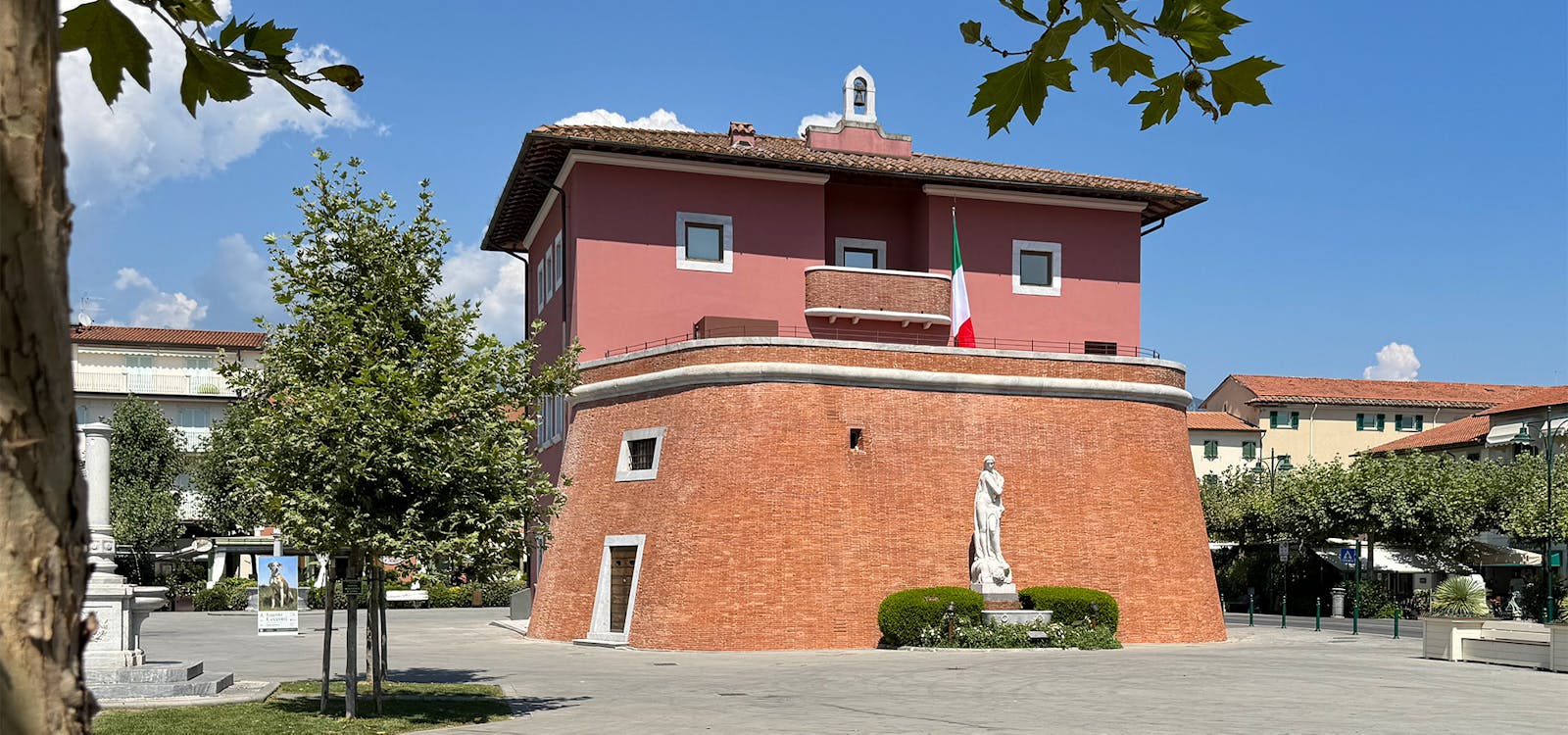
Built to serve military, customs, and sanitary functions, the Forte dei Marmi complex consists of two adjoining structures: a three-story building with a hipped roof, housing the guard corps and cavalry stables; a sea-facing bastion with chamfered corners, featuring a semi-covered terrace used for lookout and artillery placement (Fig. 5).


Fig. 5 – Wooden scale model of the Fort at the Scalo dei Marmi, based on the 18th-century design, crafted by Mr. Guglielmi Pranesi of Florence (2004)


Fig. 6 – Design for the new Fort at the Scalo dei Marmi (A. Dolcini, 1785)
URBAN DEVELOPMENT BETWEEN THE 19TH AND 20TH CENTURIES
During the 19th century, the Forte dei Marmi landing became a strategic hub throughout Versilia, making restoration of the Via di Marina essential. This intervention led to increased commercial traffic, making the port of Forte dei Marmi increasingly busy, and more people began to move to the surrounding area, leading to population growth. Between 1821 and 1822, approximately three hundred residents – mostly seafarers – settled in the area.
Beginning in the 1820s, land was granted near the Fort with permission to build warehouses and homes, many intended to host summer visitors – Tuscan nobles who came to the coast for seaside bathing.
In 1877, construction was completed on the Pontile Caricatore, the marble loading pier, five meters wide and extending 325 meters into the sea, supported by sturdy wooden piles.
Strong aspirations for autonomy animated the town in the early 20th century. The pivotal year was 1914, when, following a parliamentary proposal by the Honorable Giovanni Montauti, Forte dei Marmi officially separated from the Municipality of Pietrasanta and became an independent municipality. The Fortino was incorporated into the municipal coat of arms as the symbol of the community.
Forte dei Marmi’s status as a tourist destination, already clear in the 19th century, continued to expand, securing its position as one of the Mediterranean’s top seaside resorts. Renowned figures from culture, art, nobility, politics, and finance chose it for their stays. Consequently, the town quickly emerged as an important hub both nationally and internationally. In the 1920s, artists and intellectuals like Dazzi, Carrà, Carena, Soffici, Gentile, Pea, and Viani gathered here during summer evenings. In the next decade, their meetings moved to the Quarto Platano, now known as Caffè Roma, just a few steps from the Fortino.


Fig. 7 – Site plan listing the names of land assignees (F. Ricetti, 1823)


Fig. 8 – Urban layout of Forte dei Marmi following the first land allocations, highlighting the elevations of the Fortino and the new powder magazine (G. Calvelli, 1827)

Fig. 9 – State Archives of Lucca, General Cadaster of Tuscany, Municipality of Pietrasanta, year 1825

Fig. 10 – The well donated by Leopold II in 1843.

Fig. 11A (1955) – Sequence of historical images of the Fortino: image 11A shows the turret later demolished; image 11B shows the main façade prior to 20th-century alterations.

Fig. 11B (1955) – Sequence of historical images of the Fortino: image 11A shows the turret later demolished; image 11B shows the main façade prior to 20th-century alterations.

Fig. 11C (1955) – Sequence of historical images of the Fortino: image 11A shows the turret later demolished; image 11B shows the main façade prior to 20th-century alterations.

Fig. 11D (1955) – Sequence of historical images of the Fortino: image 11A shows the turret later demolished; image 11B shows the main façade prior to 20th-century alterations.

Fig. 11E (1955) – Sequence of historical images of the Fortino: image 11A shows the turret later demolished; image 11B shows the main façade prior to 20th-century alterations.

Fig. 11F (1955) – Sequence of historical images of the Fortino: image 11A shows the turret later demolished; image 11B shows the main façade prior to 20th-century alterations.