Five historic villages less than 30 minutes from Forte
Forte dei Marmi sits at the heart of a territory steeped in history. Just a short drive away lie a number of spectacular mountain villages, authentic witnesses to Versilia’s past, poised between Tuscany and Liguria.
SERAVEZZA
An ancient village rich in evocative views and refined architecture, Seravezza stands at the entrance to the valley where the Versilia River is born. It is here, in the heart of the village, that the Serra and Vezza streams merge, giving life to the Versilia River. In many ways, this is where Versilia truly begins.
Seravezza is well worth a visit, especially for those heading toward the mountains who wish to pause for a leisurely stroll through the center and along the riverbanks. No visit would be complete without stopping at the magnificent Palazzo Mediceo, built in the mid-1500s at the request of Grand Duke Cosimo I de’ Medici. Long used as a summer residence by Tuscany’s rulers, the palace now hosts a packed calendar of exhibitions and cultural events. Since 2013, Palazzo Mediceo has been recognized as a UNESCO World Heritage Site.


Palazzo Mediceo in Seravezza
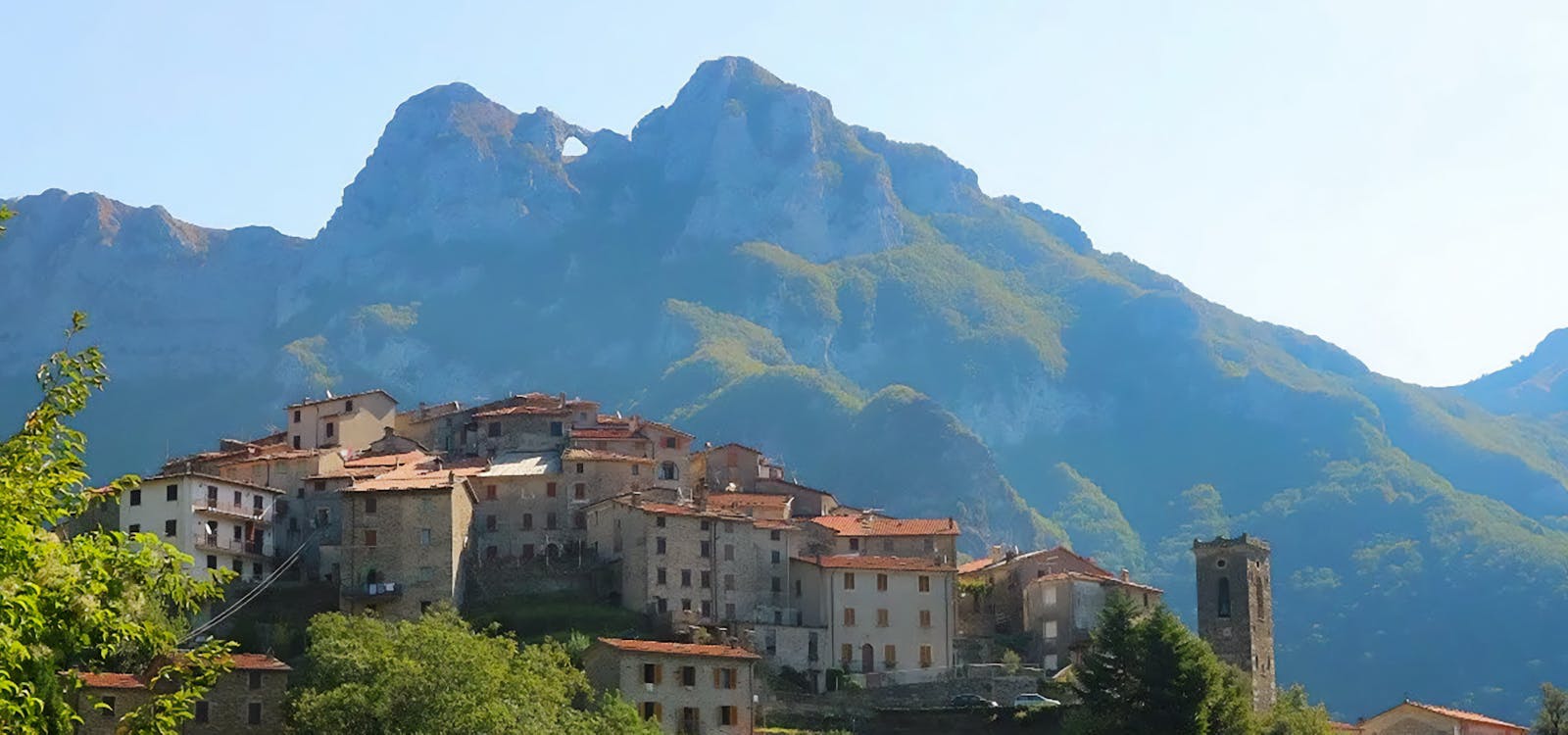
PRUNO AND VOLEGNO
These two enchanting villages rise among the peaks of the southern Apuan Alps, facing one another from opposite rocky outcrops. Quiet and contemplative, they seem suspended in time.
Here, the true protagonists are the Apuan Alps themselves. From Pruno and Volegno, visitors enjoy some of the most striking glimpses in the entire mountain range. Mount Forato, with its monumental natural stone arch, dominates the scene. From Pruno, during the summer solstice, it is possible to witness the sun perfectly aligned within the mountain’s opening. Pania della Croce, the queen of the Apuan Alps, reveals its majestic western face, soaring over 4,600 feet above the village below.
Nestled between the mountains at over 1,300 feet above sea level, Pruno and Volegno offer refreshingly cool temperatures year-round. An evening visit is particularly recommended during the hottest days of August, perhaps before or after dining at one of the excellent restaurants scattered between Cardoso, Stazzema, and Seravezza.

The quaint village of Pruno, with Mount Forato in the background
SANT’ANNA DI STAZZEMA
Sant’Anna di Stazzema is a small hamlet in the Municipality of Stazzema, perched on the hills overlooking the Camaiore valley. This quiet village was the site of one of the most tragic events of World War II. On August 12, 1944, a German SS unit carried out a brutal massacre, killing 560 civilians, 130 of them children. Today, Sant’Anna is not a place of sorrow alone, but a place of remembrance and reflection.
In 2000, the National Peace Park was established here, welcoming thousands of visitors and students from across Europe each year. The museum houses deeply moving testimonies, alongside a powerful affirmation of life and freedom.

The Peace Park in Sant’Anna di Stazzema
CAMAIORE
The village of Camaiore has pre-Roman origins. Archaeological evidence points to Ligurian and Etruscan settlements dating back to the 6th century BCE. Its decisive development came later, first under the Lombards, who fortified the surrounding hills, and then in 1226, when Camaiore was conquered by Lucca and became a strategic gateway to the sea. Another key factor in Camaiore’s growth was the Via Francigena, which passed directly through the town and served as a vital route for trade and travel along the Tyrrhenian coast.
Today, Camaiore welcomes visitors with a beautifully preserved historic center, characterized by a grid of intersecting streets lined with noble buildings from different eras.
Framing the town on three sides rise the majestic peaks of the southern Apuan Alps, offering impressive views and access to well-known mountains such as Monte Prana, Matanna, and Gabberi.


The Abbey complex of San Pietro in Camaiore